


The operational reality of the modern mortgage industry is unforgiving: a Loan Officer’s (LO) primary job is to originate new business, advise borrowers on complex financial decisions, and maintain vital relationships with lenders and real estate partners. Yet, in practice, brokers and LOs spend an overwhelming percentage of their day chasing down trailing documents, deciphering underwriting conditions, and micro managing every single file milestone. This operational bottleneck stifles growth and compresses already tight margins.
In today’s volatile rate environment, securing reliable contract mortgage processing support is no longer just a tactical advantage, it is a critical survival mechanism. Leveraging a third-party mortgage processing partnership allows modern mortgage brokerages to convert the fixed overhead costs of internal staff into a variable, per-file cost.
This comprehensive guide breaks down exactly how contract mortgage processing support operates, the economic and operational differences between in house and contract processors, and how brokers can strategically utilize this model to scale their pipelines without inheriting the burden of human resources management.
What Is Contract Mortgage Processing Support?
At its core, contract mortgage processing support is a scalable operational model where a highly trained, third party professional manages the entirety of the loan file workflow on behalf of a mortgage broker or loan officer.
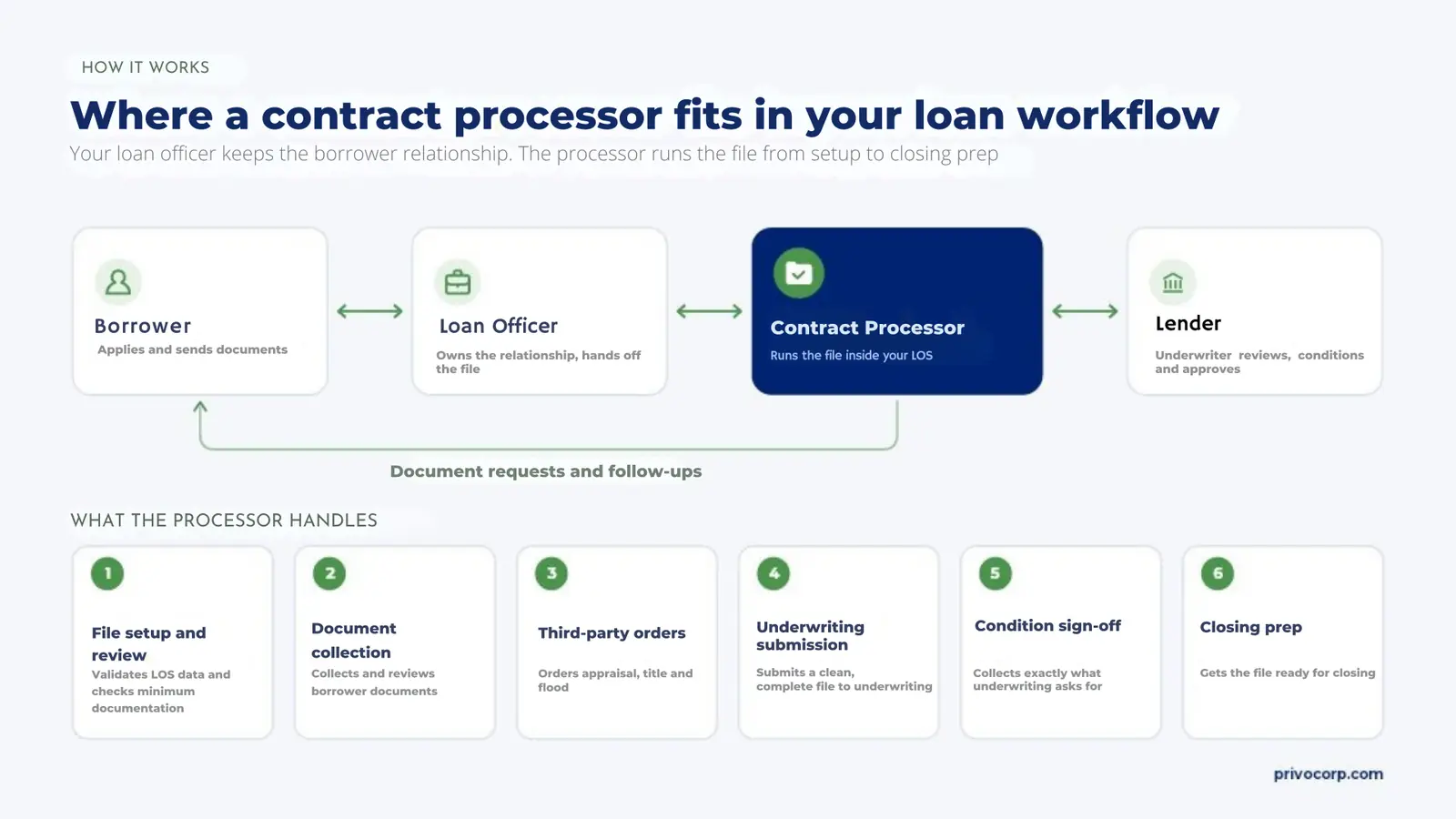
Instead of sitting on your payroll, these processing experts operate independently—or as part of a specialized B2B processing firm integrating seamlessly into your daily workflow. They execute the heavy lifting required to push a loan from application to the closing table. This includes collecting and reviewing complex borrower documentation, ordering necessary third party services (like appraisals, title work, and insurance), meticulously tracking underwriting conditions, preparing the final file for underwriting review, and coordinating all closing logistics with the title company, escrow officers, and the lender.
Crucially, utilizing contract mortgage processing support does not mean surrendering control of your business. The broker or loan officer retains absolute authority over the borrower relationship, lender selection, pricing strategies, and overall origination tactics.
Financially, this relationship is typically structured on a variable basis. The contract processor is compensated through a disclosed, per-file processing fee that is often built into the loan’s closing costs. This means the broker only pays for processing when a loan actually closes, effectively eliminating the financial drain of paying a
full time salary during slow months.
The Structural Divide: Contract Processor vs. In House Processor
Deciding whether to build an internal operations team or leverage external contract mortgage processing support comes down to analyzing cost structures, scalability, and management bandwidth. Understanding the differences is vital for any Operations Manager or Branch Manager looking to optimize their P&L.
Below is a detailed operational comparison of the two models:
| Operational Factor | In House Mortgage Processor | Contract Mortgage Processing Support |
|---|---|---|
| Cost Structure | Fixed: Monthly salary, benefits, PTO, payroll taxes, hardware, and LOS seat licenses. | Variable: Usually a per file or per closed loan processing fee. No hidden HR overhead. |
| Capacity & Scalability | Static: Strictly limited to one individual’s bandwidth (typically 15-25 files per month). | Dynamic: Scales instantly with pipeline volume. Provider can deploy multiple processors during spikes. |
| Operational Coverage | Vulnerable: Workflow stops or slows during vacations, illness, or employee turnover. | Continuous: B2B providers offer built in backup coverage and redundancy. |
| Management Burden | High: Broker must handle recruiting, hiring, training, payroll, and daily performance management. | Low: The provider handles all HR, training, oversight, and operational QC. |
| Ideal Business Fit | Consistently high volume that mathematically justifies a permanent $60k-$80k+ annual salary. | Variable volume, rapid growth phases, seasonal spikes, or permanent overhead reduction strategies. |
Analyzing the Economic Impact
According to the Mortgage Bankers Association’s (MBA) Quarterly Mortgage Bankers Performance Report, total loan production expenses at independent mortgage banks rose to $11,615 per loan in the third quarter of 2026. MBA also noted that production staffing per firm held roughly flat even as loan volume dropped. By shifting to a contract mortgage processing support model, brokerages convert a massive fixed operational expense into a variable cost, protecting their profitability regardless of market fluctuations.
The Breaking Point: When Contract Mortgage Processing Support Makes Sense
Many brokerages stubbornly hold onto the in house model long past its point of efficiency. Recognizing the right time to pivot to contract mortgage processing support is a hallmark of strong executive leadership. The transition typically makes sense under the following scenarios:
1. The LO Is Drowning in File Follow Up
When a top producing loan officer is spending three hours a day auditing Debt to Income (DTI) ratios, calling employers for VOEs, and begging borrowers for updated bank statements, they are not originating. Integrating contract mortgage processing support frees the LO to focus entirely on revenue generating activities.
2. The Brokerage Faces Seasonal or Inconsistent Volume
The mortgage industry is inherently cyclical. Maintaining a full time processor on payroll during the slow winter months drains capital. A contract model ensures that you only pay for processing capacity when you actually have loans in the pipeline.
3. Scaling Without Full Time Commitments
When a brokerage is expanding into new states or launching new marketing initiatives, predicting exact volume is impossible. Contract mortgage processing support allows a growing team to test the waters and scale up operations without committing to the legal and financial obligations of another full time hire.
4. Branch Overflow During Rate Drop Surges
When interest rates drop suddenly, refinance booms can break an in house operations team. A sudden influx of 50 new applications will overwhelm a single processor, leading to missed lock expirations and furious borrowers. External partners can act as an overflow valve, handling the excess volume to ensure service levels never drop.
5. Strategic Overhead Reduction
For Operations Managers auditing the P&L, cutting fixed overhead without sacrificing client service is the ultimate goal. Replacing departing internal staff with contract mortgage processing support permanently streamlines the balance sheet.
Related reading: 3 Proven Strategies for Mortgage Brokers to Maximize Profitability
Also worth reading: Scaling Lending Operations with Outsourced Mortgage Processing Support
Granular Operations: What Contract Mortgage Processing Support Handles
To truly appreciate the value of a B2B processing partner, one must understand the depth of their daily operational checklist. A premium provider of contract mortgage processing support acts as the central nervous system of your loan pipeline.
Here is exactly what they take off your plate:
- Initial File Setup and Document Auditing: Upon receiving the executed application, the processor scrubs the file, issues the initial document checklist, and flags potential underwriting red flags immediately.
- Relentless Borrower Follow Up: They handle the tedious collection and review of all income, asset, and credit documentation, ensuring everything from tax transcripts to Letters of Explanation (LOEs) are formatted perfectly.
- Third Party Services Coordination: The processor independently orders and tracks appraisals, title commitments, escrow instructions, flood certifications, and homeowners insurance (HOI).
- Compliance and Disclosure Coordination: Where applicable, they assist in coordinating the Loan Estimate (LE) and Closing Disclosure (CD) to ensure strict adherence to TRID compliance timelines.
- Flawless Underwriting Submission: They stack and package the file precisely to the specific lender’s preferences, ensuring a clean, rapid initial decision.
- Aggressive Condition Clearing: When conditional approval is issued, the processor takes the lead on gathering exactly what the underwriter requires, preventing the endless back and forth that frustrates borrowers.
- Pre Closing Readiness: They coordinate the final balancing of fees with the title company, clear the “clear to close” (CTC) milestones, and ensure funding happens on schedule.
Crucial Compliance Note: It is vital to note that contract mortgage processing support personnel do not make underwriting decisions. They do not replace the lender’s internal underwriting staff. The contract processor’s job is to prepare, coordinate, and advocate for the file; the actual credit decision and final underwriting always remain strictly with the lender.
Retaining Control: What the Broker or Loan Officer Still Owns
A common hesitation among brokers is the fear of losing control over their files. Implementing contract mortgage processing support is about delegating tasks, not abdicating responsibility. To maintain compliance with state regulators and the Consumer Financial Protection Bureau (CFPB), the broker always retains ownership of the most critical aspects of the loan.
When you utilize this model, you still own:
- The Borrower Relationship and Communication Strategy: You dictate how and when the borrower is spoken to, and you remain their trusted financial advisor.
- Loan Product and Lender Selection: The processor executes the plan; you create the plan. You determine which wholesale lender and product best fits the borrower.
- Pricing, Concessions, and Lock Decisions: All margin management, rate locks, and extension decisions remain squarely in the broker’s hands.
- Final Review of Loan Structure: The LO retains the final say on the overarching structure of the mortgage.
- Compliance Oversight and Licensing: The broker of record maintains all corporate licensing responsibilities and overall compliance oversight.
- Approval of File Specific Exceptions: If a major issue arises requiring a borrower commitment or lender exception, the LO steps in to negotiate.
Vetting the Right Partner: How to Choose Contract Mortgage Processing Support
Not all third party processing firms are created equal. Handing over your borrower data and pipeline velocity requires immense trust. When evaluating providers for contract mortgage processing support, use this definitive executive checklist to vet their operational maturity:
1. Product and Lender Versatility
Your partner must have deep experience across your specific loan types. If your brokerage relies heavily on
Non-QM, VA, FHA, or jumbo products, a processor who only understands conventional agency loans will be a liability.
2. LOS and Tech Stack Fluency
Familiarity with your specific Loan Origination System (LOS) whether it’s Encompass, Arive, Calyx Point, or Lending Pad is non negotiable. Seamless API integration and portal familiarity prevent data silos and double entry errors.
3. Clear SLAs and Turnaround Times
Vague promises do not close loans. Demand defined Service Level Agreements (SLAs). How fast do they issue the initial needs list? How quickly do they submit conditions once received? Your contract mortgage processing support partner must commit to hard numbers.
4. Defined Communication Cadence
Will the processor speak directly to your borrower? If so, are they white labeled under your brand? Establish exactly how often the LO and the borrower will receive pipeline status updates.
5. Documented QC Protocols
Ask about their internal Quality Control process. A premium provider will have a secondary peer review system before the initial underwriting submission and before the final clear to close to ensure zero unforced errors.
6. Licensing and State Coverage Transparency
State laws dictate processing requirements. Ensure the provider’s NMLS licensing aligns seamlessly with the states in which your brokerage originates.
7. Bank Grade Security and Access Control
Because they handle highly sensitive Non-Public Personal Information (NPI), your contract mortgage processing support partner must demonstrate rigorous data security practices, encrypted communications, and strict access control policies.
Related reading: 5 Effective Strategies to Stay on Top of Mortgage Compliance Requirements
A True Partnership: Contract Mortgage Processing Support Is Not Just Outsourcing
It is essential to differentiate premium contract mortgage processing support from cheap, commoditized, offshore data entry outsourcing.
Generic outsourcing often involves an anonymous pool of task workers executing simple, repetitive clicks without understanding the holistic narrative of a mortgage file. This leads to missed nuances, frustrated underwriters, and angry real estate agents.
Conversely, a true processing partnership positions the service as a strategic extension of your internal team. High level contract mortgage processing support provides:
- A named, dedicated processor (or a small, consistent pod) assigned specifically to your brokerage.
- Direct, real time communication channels (via Slack, Teams, or direct dial) between the LO and the processor.
- Deep familiarity with the broker’s preferred wholesale account executives and specific lender overlays.
- Proactive, rather than reactive, condition management anticipating what the underwriter will ask for before they ask for it.
- Borrower friendly, empathetic updates that protect and elevate the broker’s brand reputation.
By choosing a partner rather than just a vendor, brokers can leverage scalable support during extreme volume changes without ever compromising the bespoke, white glove service that local borrowers demand.
Conclusion
Surviving and thriving in the competitive mortgage space requires ruthless operational efficiency. Every hour a loan officer spends reviewing bank statements is an hour they aren’t building referral partnerships. By integrating contract mortgage processing support, modern brokerages can break the traditional constraints of fixed cost HR management.
They gain a dynamic, scalable operations team that handles the intricate, tedious mechanics of file management, ensuring loans close faster and borrowers remain delighted. Ultimately, this structural shift empowers originators to do what they do best: originate.
See how contract mortgage processing can give your team reliable file support without adding in house payroll.
Frequently Asked Questions
How much does contract mortgage processing support cost per file?
The cost typically ranges between $600 and $1,200 per closed loan, depending on the complexity of the file (e.g., conventional vs. Non-QM), regional market standards, and the specific B2B processing provider. Crucially, this fee is highly variable, meaning you only pay when the loan successfully funds, and it can often be disclosed and absorbed as a third party fee on the Closing Disclosure (CD).
Do I need to provide LOS access for contract mortgage processing support?
Yes, most top tier contract processors will require seat access to your Loan Origination System (such as Encompass, Arive, or Calyx). This ensures that all borrower data, compliance audits, and document trails remain securely housed within your own controlled environment, maintaining data integrity and regulatory compliance.
How long does it take to onboard a contract mortgage processing support team?
A highly professional processing partner can typically complete onboarding within 5 to 10 business days. This timeframe covers establishing LOS access, aligning on communication preferences, setting up encrypted email channels, and reviewing the broker’s preferred wholesale lender portals and specific operational workflows.
Who communicates with the borrower when using contract mortgage processing support?
This is entirely customizable based on the broker’s preference. Premium processors can act as a fully white labeled extension of your team, communicating directly with the borrower to collect documents and clear conditions. Alternatively, if the LO prefers to control all direct borrower contact, the processor can work entirely behind the scenes, communicating solely with the LO and the lender.
Does contract mortgage processing support cover non-QM and commercial loans?
Yes, but it requires selecting a specialized partner. While all processors handle standard Agency (Fannie/Freddie) and Government (FHA/VA) loans, processing Non-QM (such as bank statement loans or DSCR) or commercial files requires specific expertise in alternative income calculation and entity document reviews. Always verify a provider’s specific product experience before onboarding.