

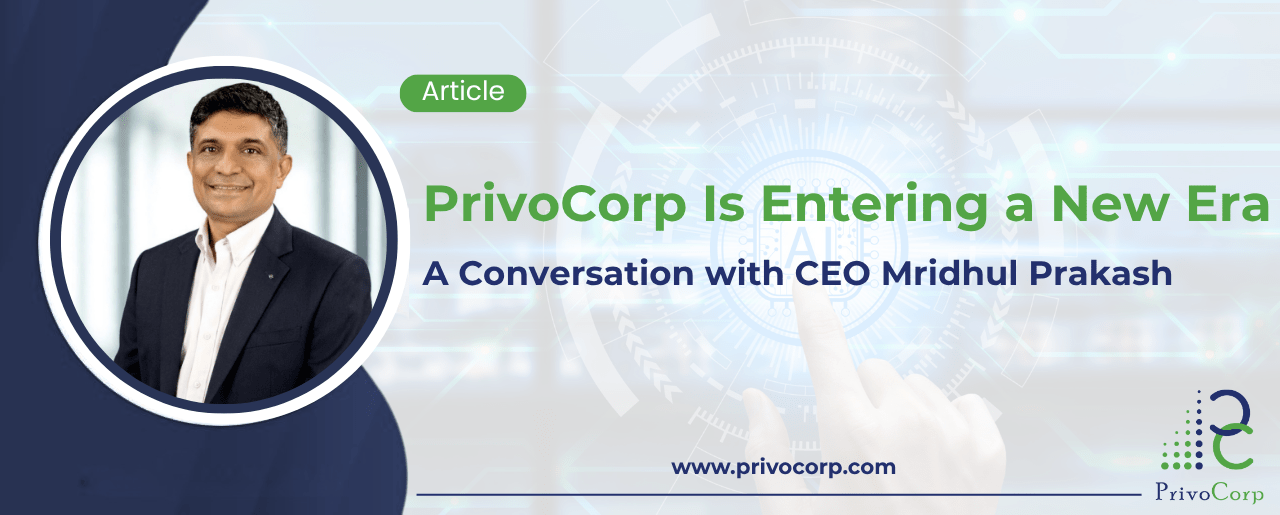
PrivoCorp has recently introduced a refreshed brand identity, launched a new website, and announced changes to its leadership team. But according to CEO Mridhul Prakash, those are the visible signs of a much larger shift taking place within the company.
The mortgage industry itself is changing. AI and automation are beginning to alter not just how mortgage work gets done, but what work needs to be done by people in the first place.
We sat down with Mridhul to discuss why he believes the traditional outsourcing model is evolving, where AI can genuinely make a difference, and how PrivoCorp is preparing for the next generation of mortgage operations.
1. Why did you decide to take over as CEO now?
I’ve been involved with PrivoCorp from the beginning, so this wasn’t really about stepping into a new business. It was about deciding where we want to take it next.
For much of the last twenty years, the mortgage outsourcing model was relatively straightforward: move repetitive operational work to a lower-cost environment, build good processes around it, and add or reduce people as volumes changed.
That model created real value, and it still does. But I don’t think it is enough for what comes next.
AI, automation and better access to data are changing what can be done without human intervention. At the same time, lenders are under enormous pressure to control costs without compromising compliance, quality or the borrower experience.
That combination creates an opportunity to rethink mortgage operations rather than simply make the existing model incrementally cheaper.
That’s the transformation I want PrivoCorp to focus on.
2. The mortgage industry has changed significantly over the last decade. What stands out the most?
Complexity arising from compliance.
There are more systems, more data, more compliance requirements and higher expectations from borrowers, but many operational processes still involve people moving information between systems, checking documents, following up on exceptions and performing repetitive tasks.
The industry has invested heavily in technology, yet we haven’t always seen a corresponding reduction in operational complexity.
I think the next phase has to be different.
Instead of asking, “How do we perform this process more efficiently?”, we should also be asking, “Why does this process require this much human intervention in the first place?”
That’s a fundamentally different question.
3. Why is AI becoming so important in mortgage operations?
I don’t think the biggest impact will come from suddenly replacing entire departments with AI.
It will come from eliminating thousands of small manual activities that consume people’s time every day.
Reading documents. Extracting information. Comparing data across systems. Identifying missing information. Prioritizing work. Detecting exceptions. Performing routine quality checks. Determining which files actually require someone’s attention.
Individually, these activities don’t sound revolutionary. Collectively, they represent a significant portion of the operating cost and cycle time within mortgage operations.
If technology can handle more of that work reliably, experienced people can concentrate on exceptions, judgment, borrower situations and decisions where their expertise actually creates value.
That’s where I think AI becomes genuinely interesting.
4. How is PrivoCorp evolving to meet these changes?
We’re moving from thinking of ourselves primarily as an outsourcing company toward becoming a technology-enabled mortgage operations partner.
That distinction matters.
Our goal isn’t simply to put people behind a process. We want to understand the process, identify where unnecessary manual work exists, determine where technology can improve it, and then apply experienced mortgage professionals where human judgment actually adds value.
Sometimes the right solution will be automation. Sometimes it will be AI. Sometimes it will simply be a better process.
And sometimes the answer will still be an experienced mortgage professional.
The objective isn’t to use technology for its own sake. The objective is to produce a better operational outcome.
5. How is this different from traditional outsourcing?
The traditional outsourcing question was often:
“How much cheaper can you do this?”
I think the more interesting question today is:
“Why does this process require this much human effort in the first place?”
Labor arbitrage will continue to have value, particularly in an industry where volumes can fluctuate dramatically. But simply moving the same process to a lower-cost location doesn’t fundamentally change the process.
The opportunity now is to combine mortgage expertise, technology and a flexible operating model.
That changes the conversation from the number of people assigned to an account to the outcomes being produced: turnaround time, quality, productivity, compliance, scalability and ultimately the cost of completing the work.
I believe that’s where mortgage operations is heading.
6. What differentiates PrivoCorp today?
With a healthy amount of skepticism…
A good AI demonstration is relatively easy to produce. Mortgage operations are much harder.
Mortgage files contain exceptions, incomplete information, unusual borrower situations, inconsistent documents and regulatory considerations. A system that performs impressively on the straightforward 90% can still create serious operational problems if it doesn’t know what to do with the remaining 10%.
So I’m less interested in whether an AI system can perform a task in a demonstration and more interested in what happens when it isn’t certain.
Does it recognize the exception?
Does it escalate appropriately?
Can a human understand why something was flagged?
Can the organization maintain the appropriate controls and audit trail?
In mortgage operations, exception management may ultimately be more important than the AI model itself.
7. Where will PrivoCorp focus its investments over the next few years?
In three areas: technology, operational intelligence and people.
We will continue investing in AI and automation where we believe they can materially improve mortgage workflows. We also want to make better use of the operational data generated across those workflows.
But I don’t see technology and people as competing investments.
If technology removes repetitive work, the value of experienced people actually increases because their time can be concentrated on situations requiring judgment, problem-solving and client interaction.
The skill set of a mortgage operations professional five years from now may look quite different from the skill set of the past.
We want to prepare our people for that environment rather than pretend it isn’t coming.
8. How do you balance technology with human expertise?
I don’t subscribe to either extreme.
I don’t believe AI is going to replace everyone. I also don’t believe we can say that technology will simply “assist people” and otherwise everything will remain the same.
Some tasks will disappear.
Some roles will become dramatically more productive.
Some jobs will change.
And there will continue to be areas of mortgage operations where experienced human judgment remains essential.
Our job isn’t to protect every task that exists today.
Our job is to make sure people spend their time on the tasks where their knowledge and judgment actually create value.
That is a much healthier way to think about AI.
9. What advice would you give mortgage industry leaders today?
Don’t start by asking, “Where can we use AI?”
Start with the business problem.
Where are you spending the most time?
Where are errors occurring?
Where are files waiting?
Where are people repeatedly performing the same task?
Where are borrowers or employees becoming frustrated?
Once you understand those problems, then determine whether AI, automation, process redesign or simply better management is the right answer.
I would also be careful about automating inefficient processes.
Automating a bad workflow can simply give you a faster bad workflow.
Fix the process first. Then decide what technology belongs inside it.
10. What excites you most about the future?
We have an opportunity to help build a different kind of mortgage operations company.
PrivoCorp already has something that is difficult to create quickly: years of operational experience and people who understand how mortgage work actually gets done.
Now we can combine that knowledge with technology that simply wasn’t available to us a few years ago.
I don’t think the winning model will be purely technology or purely people.
It will be an operating model where technology handles more of the predictable work, experienced professionals handle judgment and exceptions, and clients ultimately buy outcomes rather than headcount.
That’s the direction we’re building toward.
Looking Ahead
The changes underway at PrivoCorp – from its new identity and leadership structure to its investments in technology – reflect a broader view of where mortgage operations is heading.
For decades, outsourcing largely focused on where work was performed and what it cost.
The next era may be defined by a different question:
How much of that work should need to be performed manually at all?
For PrivoCorp, answering that question is becoming central to what comes next.